
AiGain Tech

DIY AI / CONCEPT SERIES

Your models.
Your hardware.

Install compatible open models, build an agent, connect a camera or explore fine-tuning. Start with a modular platform that matches what you want to learn and build.

Concept configurations for co-development. These are not stocked products, validated AiGain kits or published reference designs. Final components, model compatibility, price and delivery are agreed after a feasibility review.
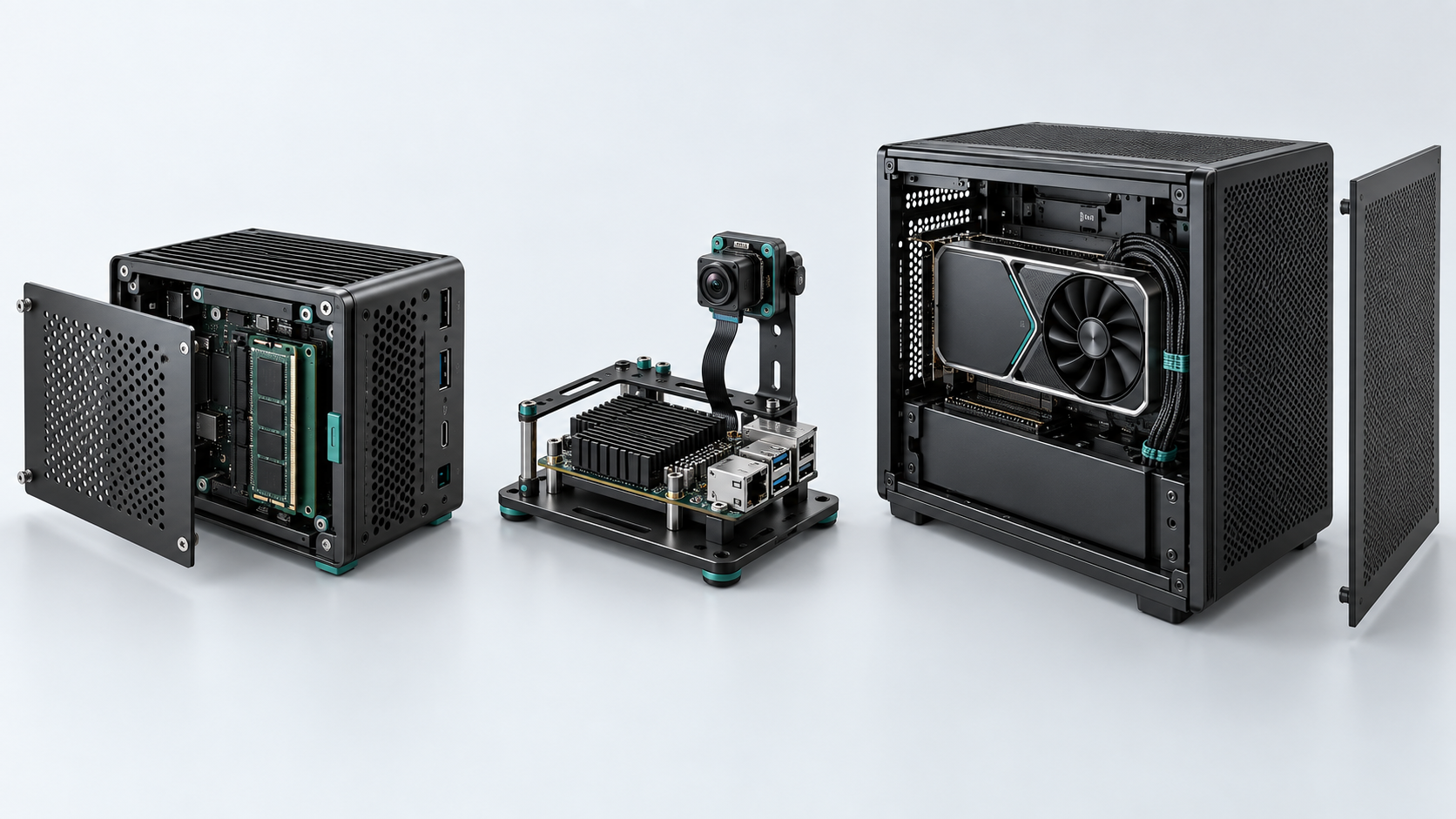
Concept illustration of a modular AI mini PC, an edge vision development device and a GPU workstation
AI-generated concept illustration. Design directions only; not photographs of manufactured AiGain products.

Run a model

Inference uses existing model weights. Memory, quantization and context length determine what fits.

Adapt a model

Fine-tuning adjusts a pretrained model using your data. LoRA/QLoRA can reduce the resources needed.

Train from scratch

Small learning experiments are possible. Large foundation-model pretraining is a separate, much larger infrastructure project.

DIY

LOCAL INFERENCE + AGENT DEVELOPMENT

Agent Box

A modular desktop starting point for local assistants, document search and tool-using agents.

Hardware direction
Proposed starting configuration: Linux-compatible x86 mini PC, 32–64 GB RAM, 1 TB NVMe SSD and optional GPU expansion on a suitable chassis.
Software direction
Evaluate Ollama or llama.cpp with a compatible, appropriately licensed model. Add an agent runtime and explicitly approved tools.
What to validate
CPU-only performance depends on model size and context. This is primarily an inference and development concept, not a large-model training system.
Customization
Memory, storage, enclosure, deployment image and documentation.
Discuss Agent Box ↗
DIY

CAMERAS + LOCAL AI INFERENCE

Edge Vision Kit

An accessible prototype platform for vision experiments, connected sensors and robotics peripherals.

Hardware direction
Candidate platform: NVIDIA Jetson Orin Nano Super developer kit with 8 GB shared memory, NVMe storage, a compatible camera and active cooling.
Software direction
Evaluate supported JetPack software, a suitable vision model and the device interfaces required by the application.
What to validate
Inference is the main target. Larger-model training should run on separate GPU hardware; trained models can then be evaluated on the edge device. No benchmark has been measured for this AiGain concept.
Customization
Camera, lens, enclosure, mounting, sensors and connectivity.
Discuss Edge Vision Kit ↗
DIY

SMALL DEVICES + HANDS-ON LEARNING

Maker AI Node

A DIY node for learning local AI, sensing and device integration with replaceable modules.

Hardware direction
Candidate platform: Raspberry Pi 5 with a compatible AI HAT+ 2, suitable power supply and cooling. The HAT provides its own 8 GB memory.
Software direction
Use the supported Hailo software and compatible models. This is a separate software path from a general-purpose GPU workstation.
What to validate
The accelerator targets inference. It does not run every open model, and is not proposed as a general-purpose training accelerator.
Customization
Sensors, camera or audio peripherals, housing and learning documentation.
Discuss Maker AI Node ↗
DIY

LOCAL INFERENCE + PARAMETER-EFFICIENT FINE-TUNING

Personal AI Lab

A serviceable workstation concept for developers who want to experiment with their own datasets and model adaptations.

Hardware direction
Proposed starting configuration: a supported GPU with 24–32 GB VRAM, 64–128 GB system RAM, 2 TB NVMe storage and a power/cooling design sized for the final components.
Software direction
Evaluate PyTorch, Transformers and PEFT for LoRA/QLoRA workflows, with version-compatible drivers and a tested environment.
What to validate
Feasibility depends on the exact model, sequence length, batch size and training method. This is not a promise to pretrain a large foundation model. Small educational models can be scoped separately.
Customization
GPU and memory options, quiet cooling, assembly, environment setup and reproducible training examples.
Discuss Personal AI Lab ↗

A useful DIY package

An agreed package can include a bill of materials, assembly guide, wiring and mechanical files, installation steps, a small test dataset and a validation checklist. Proprietary module internals and third-party licenses remain outside any blanket open-source promise.

Platform references

References checked September 2026. Platform names identify candidate components and do not imply a partnership or endorsement.

Build the next step with us.

Share your target model, workload, budget range and the part you want to build yourself. We can scope hardware, assembly and technical support around it.